
人工种植人参 · 中国高稀有皂苷红参提取物Red ginseng extract rich in minor ginsenosides
红参提取后再经皂苷转化加工,按供应商规格,稀有人参皂苷占总皂苷一半以上。
Red ginseng extract with an added ginsenoside-conversion step; by supplier specification, minor ginsenosides make up more than half of total ginsenosides.
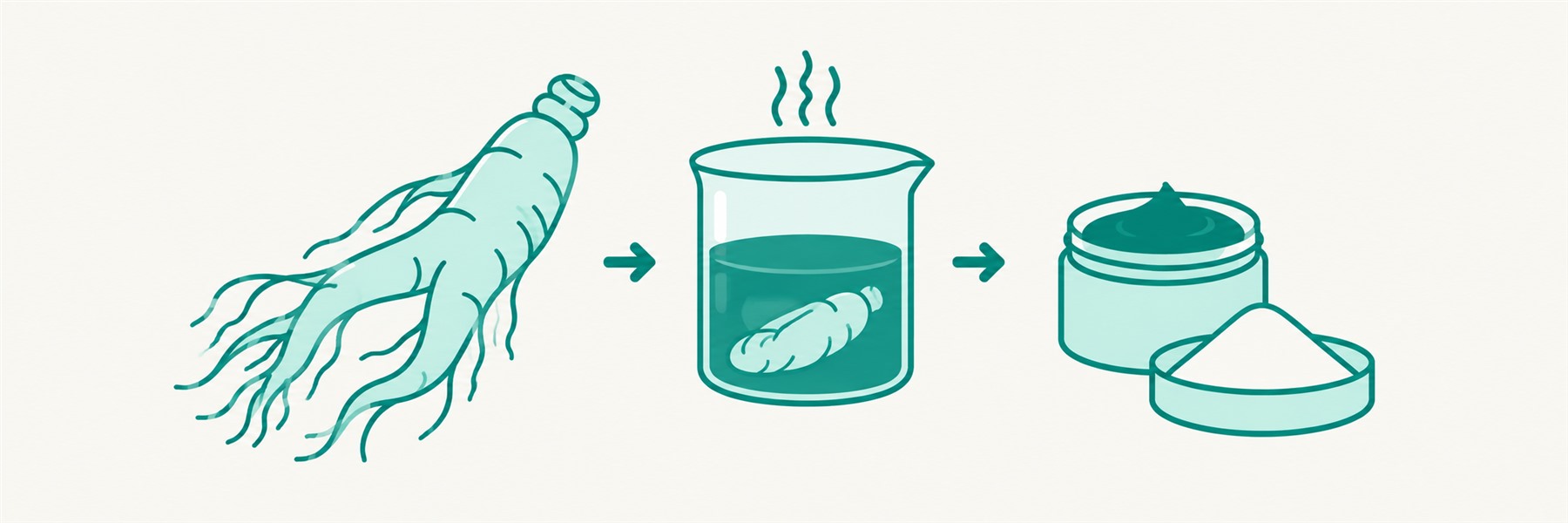
人工种植人参经蒸制成红参后提取、转化而得;红参膏与红参冻干粉两种形态Extracted and converted from steamed cultivated ginseng root; supplied as a concentrate or a freeze-dried powder
- 原料 Source
- 人参 Panax ginseng C. A. Mey.,人工种植,根及根茎
- 形态 Form
- 红参膏;红参冻干粉
- 总皂苷 Total ginsenosides
- 膏 ≥ 5%;冻干粉 ≥ 6.5%(供应商规格)
- 稀有皂苷 Minor ginsenosides
- 膏 ≥ 3%;冻干粉 ≥ 3.5%(供应商规格)
- 主要转化产物 Main products
- Rg3、Rk1、Rg5、Rh2 等(供应商色谱图)
- 检测方法 Method
- 单体皂苷 HPLC 方法与计入单体以规格书为准
- 食用量 Intake
- 折算人参 ≤ 3 g/天
- 法规身份 Status
- 人参(人工种植)为中国新食品原料;转化提取物用于普通食品的身份按个案确认
新食品原料 · 人参(人工种植)膏 · 冻干粉两种形态不宜人群须标示
它是什么What it is
红参是人参蒸制后的干燥品。蒸制过程中,人参里含量最高的几种皂苷(Rb1、Rc、Rb2、Rd、Re、Rg1)会部分脱去糖基、发生构型变化和脱水,生成天然含量很低的「稀有皂苷」,如 Rg3、Rk1、Rg5、Rh2。这款原料在红参提取之后再加一道皂苷转化工序,把这一比例进一步提高。它是多种皂苷和其他人参成分的混合物,不是单一化合物,质量应以单体皂苷谱而不是单一数字来定义。
Red ginseng is ginseng root that has been steamed and dried. Steaming partly strips sugar units from the most abundant ginsenosides (Rb1, Rc, Rb2, Rd, Re, Rg1), shifts their configuration and dehydrates them, producing "minor" ginsenosides such as Rg3, Rk1, Rg5 and Rh2 that occur only in trace amounts in raw root. This material adds a further conversion step after extraction to raise that share. It is a mixture of ginsenosides and other ginseng constituents rather than a single compound, so its quality is best defined by an individual-ginsenoside profile rather than one headline number.
- 人工种植人参Cultivated ginseng root
- 蒸制、干燥成红参Steamed and dried to red ginseng
- 提取Extraction
- 皂苷转化(供应商工艺)Ginsenoside conversion (supplier process)
- 浓缩成膏Concentrated to an extract paste
- 或真空冷冻干燥成粉Or vacuum freeze-dried to powder
- 检测 · 包装Testing · packing
组成与规格Composition & specification
供应商规格只给出两项指标:红参膏总皂苷 ≥ 5%、稀有皂苷 ≥ 3%;红参冻干粉总皂苷 ≥ 6.5%、稀有皂苷 ≥ 3.5%。供应商提供的 HPLC 色谱图显示,转化后除原有的 Rg1、Re、Rf、Rb1、Rc、Rb2、Rd 外,出现 20(S)/20(R)-Rg3、Rk1、Rg5、20(S)/20(R)-Rh2、Rg4、Rg6、Rk3、Rh4、Rk2、Rh3 等成分。「稀有皂苷」没有统一的国家检测方法,采购时应要求规格书写明检测方法、对照品和计入的单体,并按单体逐项复核。
The supplier specification gives two figures only: the concentrate has total ginsenosides ≥ 5% and minor ginsenosides ≥ 3%; the freeze-dried powder has ≥ 6.5% and ≥ 3.5%. The supplier's HPLC chromatogram shows that, after conversion, 20(S)/20(R)-Rg3, Rk1, Rg5, 20(S)/20(R)-Rh2, Rg4, Rg6, Rk3, Rh4, Rk2 and Rh3 appear alongside the original Rg1, Re, Rf, Rb1, Rc, Rb2 and Rd. There is no national standard method for "minor ginsenosides", so buyers should require the specification to state the method, reference standards and which individual ginsenosides are counted, and verify them one by one.
研究方向:加工如何改变人参皂苷组成Research area: how processing changes the ginsenoside profile
以下为已发表研究的设计与观察结果摘录,研究对象不是本原料,供研发与法规评估参考;不构成对原料或终端产品的功能宣称。
Design and reported observations of published studies. None of them tested this specific material. Provided for R&D and regulatory review only; not a functional claim for the ingredient or any finished product.
- 2001
分析方法研究:反相液相色谱测定加工人参中的低极性皂苷
Analytical method study: reversed-phase LC determination of less-polar ginsenosides in processed ginseng
测定对象为加工人参中的 F4、Rg3、Rg5、Rg6、Rk1、Rk3、Rs3、Rs4、Rs5,并把 C-20 位的 20(R)/20(S) 差向异构体和几何异构体分开。(Kwon 等,J Chromatogr A 2001; 921: 335–339)
Targets were F4, Rg3, Rg5, Rg6, Rk1, Rk3, Rs3, Rs4 and Rs5 in processed ginseng; the method separated the 20(R)/20(S) epimers and geometric isomers at C-20. (Kwon et al., J Chromatogr A 2001; 921: 335–339)
- 2019
综述,汇总大鼠等动物口服人参皂苷的药代动力学数据
Review pooling oral pharmacokinetic data for ginsenosides in rats and other animals
报告的大鼠口服生物利用度:Rb1 约 1.2–4.4%,Rd 约 2.4%,Rg1 约 6–18%,Rg3 约 2.6%,Rh2 约 4–6.4%。普通皂苷与稀有皂苷均处于较低水平。(Won 等,J Ginseng Res 2019; 43: 354–360)
Reported oral bioavailability in rats: Rb1 about 1.2–4.4%, Rd about 2.4%, Rg1 about 6–18%, Rg3 about 2.6%, Rh2 about 4–6.4%. Both major and minor ginsenosides are low. (Won et al., J Ginseng Res 2019; 43: 354–360)
- 2022
随机、开放、单剂量交叉试验,14 名健康韩国男性,生物转化红参提取物对比普通红参
Randomised, open-label, single-dose crossover trial in 14 healthy Korean men, bioconverted red ginseng extract versus conventional red ginseng
生物转化组血浆 Rg3、Rk1+Rg5、F2、CK 的峰浓度和曲线下面积高于普通红参组;研究未报告绝对生物利用度。(Kim 等,Evid Based Complement Alternat Med 2022: 8427519)
Plasma Cmax and AUC of Rg3, Rk1+Rg5, F2 and CK were higher after the bioconverted extract than after conventional red ginseng; absolute bioavailability was not reported. (Kim et al., Evid Based Complement Alternat Med 2022: 8427519)
安全性数据Safety data
人参(人工种植)作为新食品原料:孕妇、哺乳期妇女及 14 周岁以下儿童不宜食用,标签须标注不适宜人群和食用限量,折算人参 ≤ 3 g/天。《保健食品原料目录 人参》另列湿热体质、阴虚体质者不适宜,易上火者不推荐,并不宜与含藜芦、五灵脂的制品同用。一项 401 人、6 个月的 CK 富集水解人参提取物随机对照试验报告皮疹和瘙痒增多。人参是农残风险较高的品种,每批原料应有第三方农残、重金属与微生物检测。
As a novel food in China, cultivated ginseng is not recommended for pregnant or breastfeeding women or children under 14; labels must state these groups and the intake limit, equivalent to no more than 3 g of ginseng per day. The Chinese health-food raw material catalogue for ginseng also excludes people with damp-heat or yin-deficiency constitutions, advises against use by those prone to "heatiness", and warns against combining it with products containing veratrum or trogopterus dung. A 401-person, six-month randomised trial of a CK-enriched hydrolysed ginseng extract reported more rash and itching. Ginseng carries a relatively high pesticide-residue risk, so each lot should have third-party pesticide, heavy-metal and microbiological testing.
应用Applications
冻干粉适合固体饮料、压片糖果与胶囊;膏适合饮料浓浆、口服液和膏滋类产品。用量须按提取得率折算回人参,不超过 3 g/天。用于保健食品时,人参备案路径不适用于蒸制或转化工艺的原料,需走注册。转化提取物能否按红参用于普通食品,建议上市前向当地卫生健康部门确认。
The freeze-dried powder suits powdered drinks, pressed tablets and capsules; the concentrate suits beverage concentrates, oral liquids and paste-type products. Doses must be converted back to ginseng equivalent using the extraction ratio and stay within 3 g per day. For health foods in China, the ginseng notification route excludes steamed or converted materials, so registration is required. Whether a converted extract can be used in ordinary foods as red ginseng should be confirmed with local health authorities before launch.
专利与商标Patents & trademarks
- 核实中供应商专利清单与法律状态核实后公布 · To be published after verification
资料Documents
标注「申请获取」的资料受供应商约定限制,提交索样 / 询价表单并注明所需文件,我们会在核实后发送。
Documents marked "on request" are subject to supplier agreements. Submit the request form, name the files you need, and we will send them after verification.
本页信息来自供应商文件与公开发表的研究,供研发与法规评估参考,不代表原料或终端产品在中国可直接宣称相应功能。
Information on this page comes from supplier documents and published research and is provided for R&D and regulatory review. It does not constitute or permit any health-function claim for the ingredient or finished products sold within China.